Tampilkan postingan dengan label bicycle helmet 85. Tampilkan semua postingan

Rabu, 18 Juni 2014

True or False and Multiple choice, Help?!?!?


MJ


9. When a vehicle is approaching at night, your headlights must be turned to low beam when that vehicle is within ____ feet of your vehicle.
150 250 350 500
16. Bicycle helmets can reduce head injuries by _________%.
35 55 75 85
18. Forfeiting the right of way to other drivers does not prevent accidents.
â¢true â¢false
19. Properly worn seatbelts should increase the chance of survival when involved in a traffic accident by:
5% 25% 45% 75%

20. The emotions of a person have a direct impact on the way they operate a vehicle.
â¢true â¢false

21. A truck with three or more axles should never exceed 55 mph.
â¢true â¢false


Answer
9. 500
16. 85%
18. True
19. 45%
20. True
21. True

Caution: Some of these answers may be different depending on your state laws. Good luck!

Traffic school Questions. T or F? Multiple Choice.?


MJ


14. A minor adjustment to your seatbelt may be the difference between life and death.
â¢true â¢false

15. According to a new study on traffic congestion, Los Angeles area drivers spent approximately three weeks of their lives sitting in traffic.
â¢true â¢false

16. Bicycle helmets can reduce head injuries by _________%.
35 55 75 85
17. A green painted curb indicates limited time parking and the time will be marked on a nearby curb or sign.
â¢true â¢false
18. Forfeiting the right of way to other drivers does not prevent accidents.
â¢true â¢false


Answer
14. true
15. true
16. 85
17. ture
18. false

good luck


Powered by Yahoo! Answers

Senin, 07 April 2014

I need help with this 7th grade math problem..[Please Help]?


ashkan t


Problem:

Cory used 2/3 of his money to buy a used bicycle. He then bought a new helmet for $45.00 and had $15.85 left over. How much did he payed for the bicycle?

PLease show work and answer to me.


Answer
x = total amount of money Cory had.
2x/3 + 45 + 15.85 = x
2x/3 + 60.85 = x
x/3 = 60.85
x = $182.55
2/3(182.55) = $121.70 cost of bike

HOW can you paraphrase this?


killuminat


The use of a helmet is the key to reducing bicycling fatalities, which are due to head injuries 75% of the time. By cushioning the head upon impact, a helmet can reduce accidental injury by as much as 85%, saving the lives of hundreds of victims annually, half of whom are school children


Answer
If you don't wear a helmet you'll die.


Powered by Yahoo! Answers

Kamis, 16 Januari 2014

Tips for biking in the heat?

bicycle helmet 85 on Bicycle helmet. Causes, symptoms, treatment Bicycle helmet
bicycle helmet 85 image


Sam


This summer I am doing a 6-week coast to coast bike trip. We are going from South Carolina to California, so it will be upwards of 100 degrees many days and we bike an average of 85 miles a day. I really don't tolerate heat well, I get nauseous quickly and my throat begins to hurt and I feel like I have trouble breathing (I don't have asthma). I know that I need to drink A LOT of water. I will have a camelbak and two water bottles and water stops whenever possible. Does anybody have any other suggestions? Please don't say change the route because I'm going with an organization. Thanks!


Answer
You're on the right track with drinking a lot, but a sports drink will be better for you than water. It'll provide the electrolytes and carbs that you need to replace in addition to the water. I use Gatorade, straight from the bottle. Some people dilute it just a bit with water. Don't use the zero calorie stuff -- not worth drinking. Everyone I know who tried that stuff bonked because they weren't getting the carbs and calories they need to keep going.

I wear a Headsweats CoolMax skull cap under my helmet. It keeps me from getting sunburned through the helmet vents and also keeps sweat from dripping into my eyes.

And some obvious things: Good sunglasses and apply lots of sunscreen. Make sure the sunscreen does not drip into your eyes when you sweat.

Watch the movie Bicycle Dreams. There was one scene where Bob Breedlove described a fabric garment he wore in the heat that was effective in keeping him cool in the heat. RIP, Bob.

HTH

True or False and Multiple choice, Help?!?!?


MJ


9. When a vehicle is approaching at night, your headlights must be turned to low beam when that vehicle is within ____ feet of your vehicle.
150 250 350 500
16. Bicycle helmets can reduce head injuries by _________%.
35 55 75 85
18. Forfeiting the right of way to other drivers does not prevent accidents.
â¢true â¢false
19. Properly worn seatbelts should increase the chance of survival when involved in a traffic accident by:
5% 25% 45% 75%

20. The emotions of a person have a direct impact on the way they operate a vehicle.
â¢true â¢false

21. A truck with three or more axles should never exceed 55 mph.
â¢true â¢false


Answer
9. 500
16. 85%
18. True
19. 45%
20. True
21. True

Caution: Some of these answers may be different depending on your state laws. Good luck!


Powered by Yahoo! Answers

Rabu, 27 November 2013

Should i be intimidated to ride a Harley?

bicycle helmet 85 on POC Trabec Helmet Review Review - BikeRadar
bicycle helmet 85 image


Wyatt


Im 17 and really wanna get a motorcycle in the next few years. I didn't grow up with a dad so i missed out on a lot of the "man" stuff like motorcycles and cars. I have never rode a motorcycle in my life and i know nothing about them and am totally spooked about riding the first time. Is it tough? What do i need to know before trying? should i take a first time rider course? Thanks!


Answer
I read somewhere, a few years ago, that more than half of all buyers of new Harleys were either total newbies or else coming back to riding after 20-30 years (raising a family no doubt). And at the time I wondered why total noobs would want such a dauntingly big, heavy bike.

Well then a friend of mine (a woman who rides) wanted to buy one, and she began asking me questions about them. I've been riding a long time but I had never ridden a Harley. So I suggested we rent one for a day and split the cost, and take turns switching between the Harley and her bike. I have to say I was just shocked at how easy the Harley was to ride, how easy to manage and 'well mannered' it was. This was a Heritage Softail, maybe the biggest bike Harley's ever made, a 700 lb beast.

Harleys are 'cruisers'. Cruisers have a lower center of gravity, and a lower seat, so they feel much lighter than they are. Now ALL motorcycles feel pretty light once you get up to about 10 mph. On the road, weight means stability. But big bikes are a little scary when you're holding them up at a stoplight, or parking them on a slight hill. The Harley was even easy to hold up and park.

Ten minutes on this bike taught me all about cruisers. They are not good-handling, high-performance, they are stable and easy to ride. They support a relaxed, laid-back riding style, which is a lot safer than 'pushing the envelope' on a crazy sportbike. They are comfortable and relaxing to ride. The Softail would make a great touring bike, at 85 mph it's like sitting in a flying easy chair and watching the scenery go by. And I say that not exactly being a Harley fan, or a cruiser fan.

BUT I would seriously not recommend you get one to learn to ride on. You're likely to be hard on your first bike. You will almost certainly drop it once or twice (at least), nothing serious, just losing your balance in a parking lot, stuff like that. And you will almost certainly abuse the clutch. Even a halfway decent USED Harley is like $10k.

I would recommend you start on a Japanese cruiser, a used one. Honda Shadow, Kawasaki Vulcan, Yamaha Star, Suzuki C50 or Boulevard. Something between 5 and10 years old, old enough to be depreciated but new enough that you can still get parts. Maybe with a few dings and bruises already so you won't feel so bad when you drop it. 750cc is a good size to start with for a cruiser, it feels light, its easy to park, but it will still cruise on the freeway all day without the wind blowing it around. Maybe $3000. If you buy carefully, you can sell this 'old beater' a year later for about what you paid for it. And -then- if you want a Harley go get one, and it will be the same but bigger and nicer.

You don't need professional training to ride a motorcycle. You learn by yourself, by riding. The MSF course (Motorcycle Safety Foundation, in the US, in other English-speaking countries they have something similar) only teaches you some very important safety habits to keep you safe while you learn on your own. It's probably a good idea. They supply the bike, you just show up, so a lot of people do it who are just considering getting a bike and want to see what it's like and if they can even do it.

If you've never ridden a bicycle, i would start on a bicycle, just to learn about balancing and steering. If you can drive a manual-shift car, learning a motorcycle will be easier because you understand how a clutch and gearshift work. But the controls are different, you clutch with your hand and shift with your foot, so you need to develop new 'muscle memories'.

Also leave room in your budget for a helmet, jacket, and gloves, at a minimum. The gloves and jacket are about abrasion resistance when you skid on the ground.

If you know anyone who rides, pepper him with questions. Bikers love to talk (and write) about motorcycling. It really is just as much fun as it looks. 8^)

10 safety laws for riding a bicycle in town?


End Zone


I will award best answer to the first answer that is sensible and true.
Thanks


Answer
Protect Your Head. Wear a helmet!
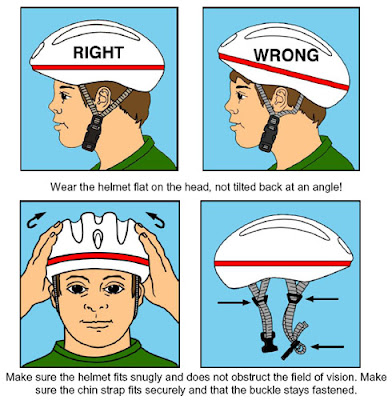
Studies have shown that using a bicycle helmet can reduce head injuries by up to 85%. Select a helmet that fits snug and comfortable. Make sure that the helmet is endorsed by the American National Standards Institute (ANSI) or Snell Memorial Foundation.

See and Be Seen. Wear proper Clothing.
Wear clothes that let you be seen by others. Clothing should be light in color and close fitting to avoid being entangled in the moving parts of a bicycle.

Go with the flow of Traffic, Stay on the right side.
A bicyclist must obey the same traffic laws as motor vehicles. Stop signs and stop lights, road marks and road signs are for a cyclist as well as a motor vehicle operator. Always use hand signals! Never weave from lane to lane or tailgate or hitch rides on moving vehicles.

Keep your Eyes on the Road. Be aware of traffic around you.
Seven out of ten car vs. bicycle crashes occur at driveways or other intersections. Before you enter a street or intersection, check for traffic and always look left, right and left. Walk your bicycle across busy streets and crosswalks.

Stay Alert, Keep a look-out for the unexpected.
Watch out for potholes, sewer gratings, cracks, railroad crossings, loose gravel, and broken glass. Before going around any object, look ahead and behind yourself for a break in traffic. Plan your move, and then signal your intention. Be especially careful in wet weather and at night.

Beware the Night! Be cautious when bicycling at night.
Always have operational front and rear lights on your bicycle when riding at night. Wear reflective clothing or material on your helmet, ankles, back and wrists. Ride in familiar areas or streets that are well lit.

Go-Off Road! Follow designated bike routes.
Bicycle routes are marked by signs and are usually rated according to their difficulty. They are reserved for bikes only and can be ideal for new riders.

Fix it up. Check your bike!
Your bike should be correctly adjusted to fit you. Your feet should rest on the ground while properly sitting on the seat. Before using your bike, check to make sure that all parts are secure and working. The handlebars should be firmly in place and the wheels should be straight and secure.

Stop it. Check your bike!
Control your speed by using your brakes. If your bike has hand brakes, apply the rear brakes before the front breaks. Remember to ride slowly on wet, slippery pavement, and to apply brakes earlier since it takes more distance to stop.

Keep your wheels on the road! Wheels should be securely fastened.
Check your wheels before every ride, after every fall, or after transporting your bicycle to insure that they are âtrueâ and properly fastened and secured. Make sure that tires are properly inflated.


Powered by Yahoo! Answers

What route should I take to drive through all 48 states without using the interstate system?

bicycle helmet 85 on Do You Know about ARAI� Helmet ??
bicycle helmet 85 image


Trey C


Me and a friend are planning on motor-biking across the country with the goal of at least entering all 48 contiguous states. We will be riding motor-bikes that will only be able to achieve about 30-40 miles per hour, so we will need to avoid the interstate system. We will have plenty of time to complete the trip, so no worries about time constraints. Anyone that could suggest a possible route would be a great help. Thanks and have a great day.


Answer
You've really put a lot of thought into this, haven't you?

Okay, sorry, look, you're talking about a landmass that is 3,000 miles by 1,000 miles (4800km x 1600km). The interstates were built because it was so difficult to construct a route across the nation.

No joke, in 1919, Lt. Dwight D. Eisenhower was part of a military experiment to see how hard it was to drive from Washington, D.C to San Francisco. It took him more than two months. When he took-over Germany 25 years later and saw the Autobahn, it was, literally, a revelation. When he became president, he built the interstates.

It is extremely difficut to hit all of the lower 48. I've moved cross-country about six times and driven cross-country more than a dozen times, and there are states I've never entered. In my entire life, I've known about a half-dozen people who have even claimed to have been in all 48, and I don't know that I really believed all of them. (Odd point, the three who basically proved it to me by showing me their travel logs were all Canadians).

Also, if you're doing this on scooters/mopeds or something similar, realize that, in a lot of the western U.S., the next gas station is 60+ miles away. My cycle has a six-gallon gas tank and I've been on reserve more than once. I knew a guy in Utah who tried to ride a scooter to Mardi Gras. He killed the scooter (literally, last day was done in the back of a friendly person's pickup) to make it across the Texas border so that he could at least say he'd gotten an entire state away from Utah.

Some suggestions:
. Buy a Rand-McNally type road atlas and study it, in depth, before you do any other planning
. Look for the scenic routes
. Realize that different states have different helmet laws
. Realize that you may not be able to get scooters repaired in a lot of places. Travel with a support truck or use some brand with a broad suport base in the U.S., such as Honda. Honestly, it would probably be less headache to do this on bicycles than on Vespas. Why not get real motorcycles and do the interstates at least part of the trip?
. Don't get hung-up on hitting all 48, or you will probably miss some really oustanding sights. F'rinstance, you'll want to see south Florida, but that will add 1,000 miles to your trip. California Highway One will take a day or three on scooters, and you will only transit about a quarter of the length of the state.
. Weather. March in Texas is pleasant. Other parts of the states are receiving six inches of snow. North Texas may be receiving six inches of snow.

Here are some roads that may be useful:
. 93/91/89 through Montano, Idaho, Utah, Arizona goes through a lot of scenic places
. Forget Route 66. Much of what exists is under interstates. Most of it goes (actually, "went")through very boring places.
Oh man, I'm having a hard time finding non-interstate routes that traverse more than one or two states. Seriously, talk to people and put some thought into this. I think you'll want something that can do more than 40 miles per day for any real travel in the U.S.

@MrDanger -- If you'd read what I wrote, you'd realize I'm trying to tell the Asker to use some other form of transportation. But anyway, I know people who have bicycled 89/85 from Canada to Mexico. I've ridden and driven most of it, and for most of it, it's a slow, pleasant drive. Just 'cause you drive like a jomoke doesn't mean everyone is a discourteous law-breaker. Speeding fools kill kids in schoolzones all the time, where the speedlimit is only 15MPH.

Are adult tricycles easy to ride or are they awkward in some way?


Miss Kimbe


I am think of buying a adult tricycle to help me walk my dogs long distances. I've seen some on line but they all seem pretty expensive. I don't want to buy it and then still not be able to ride a bike.
I am think of buying a adult tricycle to help me walk my dogs long distances. Since I have bad knees. I had an accident and the doctor said it would have been better to have broken my leg. I've seen some on line but they all seem pretty expensive. I don't want to buy it and then still not be able to ride a bike


Answer
My cousin gave me one when his company quit using them for messages and light transport within their plant. But he gave it to me on condition that I buy a helmet and never ride without it. I picked up a pretty shiny blue one at Goodwill for not much.

They are easy to ride. They do take some getting used to though. You need to practice in your driveway or other safe place before you take it on the road. The reason they seem awkward at first is because anyone who knows how to ride a bicycle will notice the very different balance feel especially in the turns.

I too have bad knees and my rheumatologist (arthritis doctor) has told me not to ride it as it puts too much strain on my knees (don't always do what I'm told). So you may want to check with your doctor before buying one.

I have two dogs and the basket on the back is just right for carrying my little terrier when his short legs get tired. The problem is with the other dog. She is a beautiful all white German Shepherd weighing about 85 pounds. With her on a leash, if she decides to go too far out to the side she can overbalance me and cause me to tip. Haven't completely resolved that yet.

There is the dork factor. Be ready for people to stare and possibly assume you are mentally challenged.

They are expensive but if you surf the net a bit you may be able to find a used one for sale.


Powered by Yahoo! Answers

Rabu, 03 Juli 2013

Should i be intimidated to ride a Harley?

bicycle helmet 85 on Motorcycle Street Bike Modular Filp up Full Face Adult... | Shop ...
bicycle helmet 85 image


Wyatt


Im 17 and really wanna get a motorcycle in the next few years. I didn't grow up with a dad so i missed out on a lot of the "man" stuff like motorcycles and cars. I have never rode a motorcycle in my life and i know nothing about them and am totally spooked about riding the first time. Is it tough? What do i need to know before trying? should i take a first time rider course? Thanks!


Answer
I read somewhere, a few years ago, that more than half of all buyers of new Harleys were either total newbies or else coming back to riding after 20-30 years (raising a family no doubt). And at the time I wondered why total noobs would want such a dauntingly big, heavy bike.

Well then a friend of mine (a woman who rides) wanted to buy one, and she began asking me questions about them. I've been riding a long time but I had never ridden a Harley. So I suggested we rent one for a day and split the cost, and take turns switching between the Harley and her bike. I have to say I was just shocked at how easy the Harley was to ride, how easy to manage and 'well mannered' it was. This was a Heritage Softail, maybe the biggest bike Harley's ever made, a 700 lb beast.

Harleys are 'cruisers'. Cruisers have a lower center of gravity, and a lower seat, so they feel much lighter than they are. Now ALL motorcycles feel pretty light once you get up to about 10 mph. On the road, weight means stability. But big bikes are a little scary when you're holding them up at a stoplight, or parking them on a slight hill. The Harley was even easy to hold up and park.

Ten minutes on this bike taught me all about cruisers. They are not good-handling, high-performance, they are stable and easy to ride. They support a relaxed, laid-back riding style, which is a lot safer than 'pushing the envelope' on a crazy sportbike. They are comfortable and relaxing to ride. The Softail would make a great touring bike, at 85 mph it's like sitting in a flying easy chair and watching the scenery go by. And I say that not exactly being a Harley fan, or a cruiser fan.

BUT I would seriously not recommend you get one to learn to ride on. You're likely to be hard on your first bike. You will almost certainly drop it once or twice (at least), nothing serious, just losing your balance in a parking lot, stuff like that. And you will almost certainly abuse the clutch. Even a halfway decent USED Harley is like $10k.

I would recommend you start on a Japanese cruiser, a used one. Honda Shadow, Kawasaki Vulcan, Yamaha Star, Suzuki C50 or Boulevard. Something between 5 and10 years old, old enough to be depreciated but new enough that you can still get parts. Maybe with a few dings and bruises already so you won't feel so bad when you drop it. 750cc is a good size to start with for a cruiser, it feels light, its easy to park, but it will still cruise on the freeway all day without the wind blowing it around. Maybe $3000. If you buy carefully, you can sell this 'old beater' a year later for about what you paid for it. And -then- if you want a Harley go get one, and it will be the same but bigger and nicer.

You don't need professional training to ride a motorcycle. You learn by yourself, by riding. The MSF course (Motorcycle Safety Foundation, in the US, in other English-speaking countries they have something similar) only teaches you some very important safety habits to keep you safe while you learn on your own. It's probably a good idea. They supply the bike, you just show up, so a lot of people do it who are just considering getting a bike and want to see what it's like and if they can even do it.

If you've never ridden a bicycle, i would start on a bicycle, just to learn about balancing and steering. If you can drive a manual-shift car, learning a motorcycle will be easier because you understand how a clutch and gearshift work. But the controls are different, you clutch with your hand and shift with your foot, so you need to develop new 'muscle memories'.

Also leave room in your budget for a helmet, jacket, and gloves, at a minimum. The gloves and jacket are about abrasion resistance when you skid on the ground.

If you know anyone who rides, pepper him with questions. Bikers love to talk (and write) about motorcycling. It really is just as much fun as it looks. 8^)

10 safety laws for riding a bicycle in town?


End Zone


I will award best answer to the first answer that is sensible and true.
Thanks


Answer
Protect Your Head. Wear a helmet!
Studies have shown that using a bicycle helmet can reduce head injuries by up to 85%. Select a helmet that fits snug and comfortable. Make sure that the helmet is endorsed by the American National Standards Institute (ANSI) or Snell Memorial Foundation.

See and Be Seen. Wear proper Clothing.
Wear clothes that let you be seen by others. Clothing should be light in color and close fitting to avoid being entangled in the moving parts of a bicycle.

Go with the flow of Traffic, Stay on the right side.
A bicyclist must obey the same traffic laws as motor vehicles. Stop signs and stop lights, road marks and road signs are for a cyclist as well as a motor vehicle operator. Always use hand signals! Never weave from lane to lane or tailgate or hitch rides on moving vehicles.

Keep your Eyes on the Road. Be aware of traffic around you.
Seven out of ten car vs. bicycle crashes occur at driveways or other intersections. Before you enter a street or intersection, check for traffic and always look left, right and left. Walk your bicycle across busy streets and crosswalks.

Stay Alert, Keep a look-out for the unexpected.
Watch out for potholes, sewer gratings, cracks, railroad crossings, loose gravel, and broken glass. Before going around any object, look ahead and behind yourself for a break in traffic. Plan your move, and then signal your intention. Be especially careful in wet weather and at night.

Beware the Night! Be cautious when bicycling at night.
Always have operational front and rear lights on your bicycle when riding at night. Wear reflective clothing or material on your helmet, ankles, back and wrists. Ride in familiar areas or streets that are well lit.

Go-Off Road! Follow designated bike routes.
Bicycle routes are marked by signs and are usually rated according to their difficulty. They are reserved for bikes only and can be ideal for new riders.

Fix it up. Check your bike!
Your bike should be correctly adjusted to fit you. Your feet should rest on the ground while properly sitting on the seat. Before using your bike, check to make sure that all parts are secure and working. The handlebars should be firmly in place and the wheels should be straight and secure.

Stop it. Check your bike!
Control your speed by using your brakes. If your bike has hand brakes, apply the rear brakes before the front breaks. Remember to ride slowly on wet, slippery pavement, and to apply brakes earlier since it takes more distance to stop.

Keep your wheels on the road! Wheels should be securely fastened.
Check your wheels before every ride, after every fall, or after transporting your bicycle to insure that they are âtrueâ and properly fastened and secured. Make sure that tires are properly inflated.


Powered by Yahoo! Answers